
How protein works for muscle building
You cannot out-train a limiting amino acid.
Muscle protein synthesis stays elevated for roughly 24 to 48 hours after training. What you eat across that whole window matters, not just the mythical 30 minutes after you rack the bar.
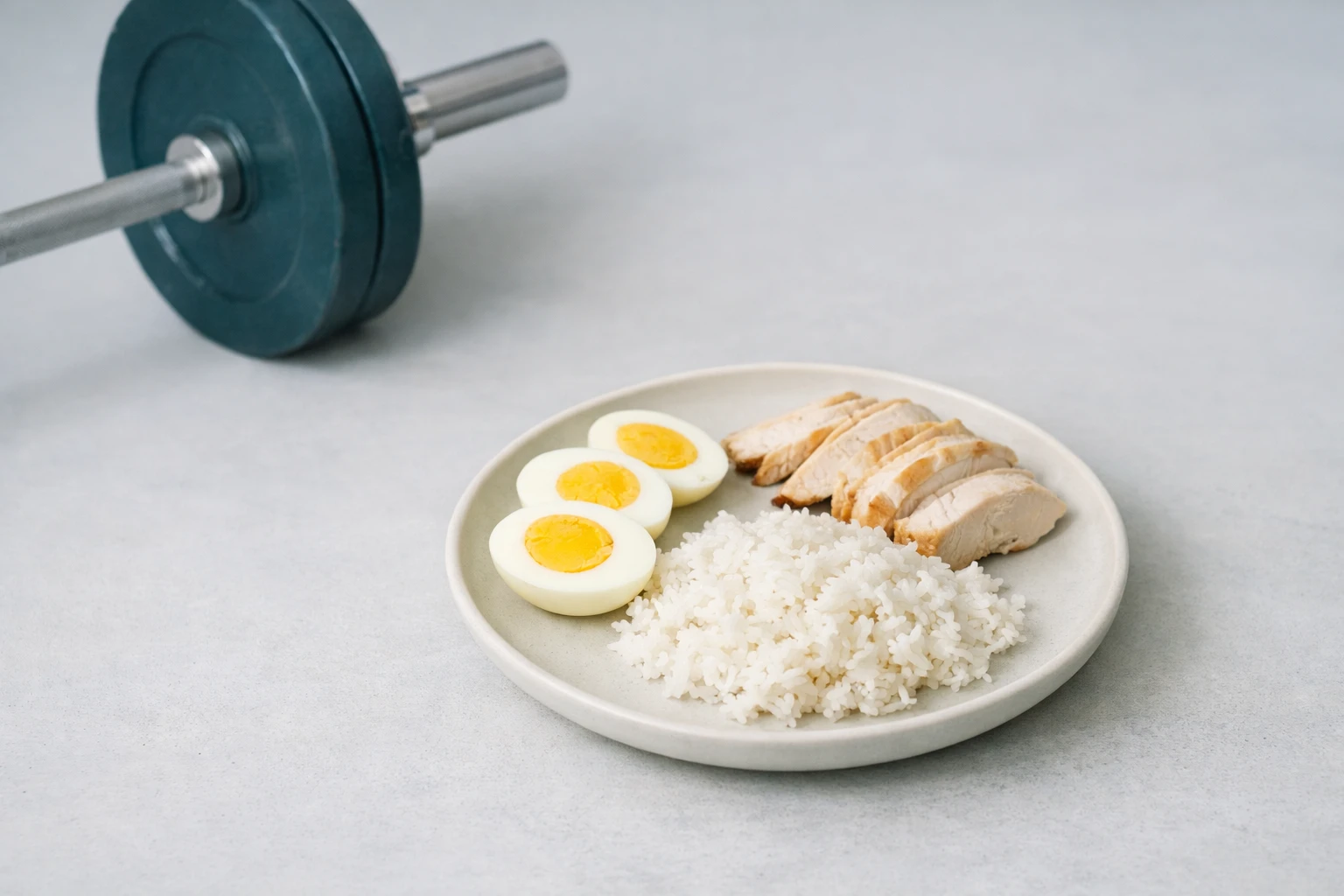
How your body actually uses it
Resistance training does two things: it causes micro-damage that has to be repaired, and it raises a growth signal that keeps synthesis elevated for a day or two afterwards. Amino acids are the bricks for both.
Leucine is the foreman. It activates mTOR, the switch that starts the job, which is why synthesis works in pulses rather than as a steady drip. Each protein feeding that clears the leucine threshold triggers a few hours of elevated building, then things return to baseline until the next one.
What most people here get wrong
The anabolic window
The idea that you have thirty minutes after training to get protein in or the session is wasted. Total daily intake and sensible per-meal distribution beat timing precision by a wide margin. If you train fasted first thing, eat reasonably soon afterwards. Otherwise, stop setting alarms.
Chasing 200 g and beyond
Research supports roughly 1.6 to 2.2 g/kg for people training hard. AminoLens publishes 1.8 g/kg as its build-muscle target, which sits inside that band. Above the band the extra is not stored for later, because there is no protein store. You are buying expensive urine.
Treating all protein as equal
30 g from collagen powder is not 30 g from eggs. Collagen has essentially no tryptophan and poor leucine, so a large share of it cannot be used for muscle at all. It counts on a label. It does not count in a muscle.
Stacking BCAAs on top of adequate protein
You need all nine essential amino acids present at once to build anything. Supplying three of them, on top of a diet that already supplies all nine, does not raise the ceiling. It just makes the shaker taste worse.
The amino acid angle
For this audience the mix question is really a per-meal question. The daily total decides whether you have enough raw material; the per-meal leucine dose decides how many times a day you actually start a build.
AminoLens fires its leucine badge at 2.5 g of digestibility-adjusted leucine in a meal. Published estimates of the threshold run from about 2.5 to 3 g, and the app deliberately commits to the lower bound, so a cleared badge is the floor rather than the target. If a meal clears it by a hair, that is a meal that just barely started the job.
The playbook
- Set the build-muscle goal and the app targets 1.8 g/kg/day. Research supports a 1.6 to 2.2 band; 1.8 is our single published figure, and if you are lean and training hard the upper half of that band is defensible.
- Take that total across 3 to 5 protein feedings rather than one or two.
- Make every feeding clear the leucine trigger. This is the rule that actually changes physiques.
- Prioritise complete sources, or deliberate complementary pairs if you are plant-based.
- Do not fear plant-based bulking. It works. It needs bigger portions, and it needs you to watch lysine and leucine density rather than assume they follow the protein number.
Where AminoLens comes in
The leucine badge exists for exactly this, and it is the reason to log meals individually rather than dumping a day in at once. The effective usable protein figure is the other half: it tells you how much of the protein you ate could actually be built with, given your weakest line.
See where your own protein goes
One photo. All nine lines. The one that is holding the rest back.
Analyse a meal